View Pippa Hale: Pet Project on Staging - Contemporary art and writing in the North and Midlands of England
]]>Lesley Guy: It’s really nice in here!
Pippa Hale: It’s a bit of a different vibe from what you’d normally expect here at the Bowes Museum.
LG: We should probably describe our setting before we proceed.
PH: So, we’re in the temporary exhibition space up on the first floor, up the very grand staircase, through some of the collections and then into this riot of colour. The space is all painted bright pink and green, and as you walk in, the first thing you’ll probably notice is these giant beanbags, twelve giant cats and twelve giant dogs that are based on objects from the museum’s collection. I’ve picked two ‘hero’ objects: there’s Cat (c1825) and Dog (1768), made in different ways for different audiences. Dog is made of Berlin porcelain. It’s probably been fired three times, it’s been hand painted, it’s a high-status dog – a King Charles Spaniel, it’s sitting on a nice stripy cushion with gold tassels and was very much intended for the wealthy elites. Cat, on the other hand, was made in a Staffordshire factory, so was mass produced, probably painted by children and women. It is a low status object, destined for markets and fairs. I chose these two because they are so different and provide access points to different histories.
LG: These hard, shiny objects have been transformed into warm friendly schmoos!
PH: Yes, it’s an interactive exhibition in three parts, trying to engage people with a hands-on experience. The beanbags are really big; you have to physically engage with them. You can lie on them, climb on them, jump on them. There are other activities as well – round the corner, we’ve had little Cat and Dog replicated: they were 3D scanned by Durham University, and we’ve had some moulds made and they’ve been slip-cast in a pottery in Stoke on Trent. So, people will be able to come and paint them in a series of workshops. The idea is to paint your own pet in the style of Cat or Dog. And then, for context, there’s a small exhibition of objects from the collection of pet figurines, and shown alongside those are some loaned by local people – so, breaking down the barriers between what is seen as legitimate and relevant and asking important questions like, ‘What is culture in the twenty-first century?’

LG: It’s really interesting this relationship between the museum and local people. Audiences have probably changed a lot since those early days when John and Joséphine Bowes opened the museum to share their collection…
PH: Well, I’ve dragged my kids around galleries and museums all their lives, bless them, and they’re kind of quite passive experiences, and you end up spending more time on the creative family activity bit. A lot of my practice is around history and how you connect people and places and make it relevant. History is really important because it tells us all about who we are, where we came from and why things are the way they are – but how do you make that interesting, even fun and exciting for children and young people? Or even for adults? So that’s where this idea came from of taking something very small, old and untouchable, and probably quite expensive, and tipping that on its head and making it massive, soft and playable.
LG: I think it is a very generous project, for those reasons. You’ve invited people in and made their relationships with their domestic objects, knickknacks, or with their pets, important. But then it’s also super generous to invite us to leap around and hug the artworks, allowing visitors the outlet of a physical experience, because it’s all very hands-off in museums usually…
PH: It is, and museums are having to reevaluate how they engage people, so there’s a shift isn’t there, from conservation and the preservation and presentation of objects, which is really important, to the stories we tell about those objects. Think about the backdrop we live in now, with social media, online gaming and the rise of AI. Those sorts of things are supposed to bring us together, but actually what we need as human beings is that physical social interaction in the same space, and those opportunities seem to be falling off the edge of a cliff! There’s a reason there’s an epidemic of anxiety and depression amongst children and young people, it’s because they’re not getting those connections. So I think museums have a really important role to play in reconnecting people with each other.
LG: Do you think in some way this could be a healing exhibition?
PH: Yeah – I think one of the reasons we have pets is that they are a calming influence on our lives. And we sometimes substitute pets with soft toys. There was a stat out there the other week about a shocking number of adults who sleep with their soft toys – this idea of having something that provides comfort and companionship. So we were thinking about other ways to animate the exhibition; maybe we’ll do story time on the bean bags, or let’s give them all names, all these crazy creatures, build relationships with them, have them in a circle for a tea party…

LG: You could have a sleepover.
PH: Oh! That would be amazing. It would be really comfy.
LG: These ones you’ve painted already look gorgeous. Are there going to be workshops where people can paint on these giant vinyl sculptures? I’m imagining acrylic paints with big brushes…
PH: Yeah, they’ll take them downstairs into the Create space. It’s a lovely bright space that really shows the direction the museum wants to go in.
LG: Can you imagine doing this project somewhere else?
PH: Hmm, possibly. But what I like is going into new places and somehow getting under the skin; so, working with collections or archives, talking to local people, talking to the staff who work there and then making something specifically. I don’t tend to repeat things; I like to make new things.
LG: You have a diverse practice but play seems to be a recurrent theme.
PH: Yes, since having kids our experiences as a family were diametrically opposed – on the one hand we’d be taking them to soft play areas and play grounds, which contain this sort of static, nailed down equipment in primary colours, and then on the other hand, going to galleries and museums where everything is amazingly inspirational but you can’t touch any of it. It’s really frustrating, so I wanted to think about how I could bring those two things together and make something that was conceptually interesting, aesthetically adventurous but that was accessible and playable and fun and trying to hook people in in a different way. And it’s not just for kids – all the adults who have been in here have been just as delighted, because we don’t often get a chance to play, we don’t get permission as adults, so being able to come and bounce around on a load of beanbags, I mean, what’s not to like about that?
Lesley Guy is an artist and writer based in Newcastle upon Tyne.
Pippa Hale: Pet Project is on at The Bowes Museum from 26 July to 1 March 2026.
This review is supported by The Bowes Museum.
View Pippa Hale: Pet Project on Staging - Contemporary art and writing in the North and Midlands of England
]]>View Pepperpot The Mole & Final Boss: Bruce Asbestos’s Pop Cultural Follies on Staging - Contemporary art and writing in the North and Midlands of England
]]>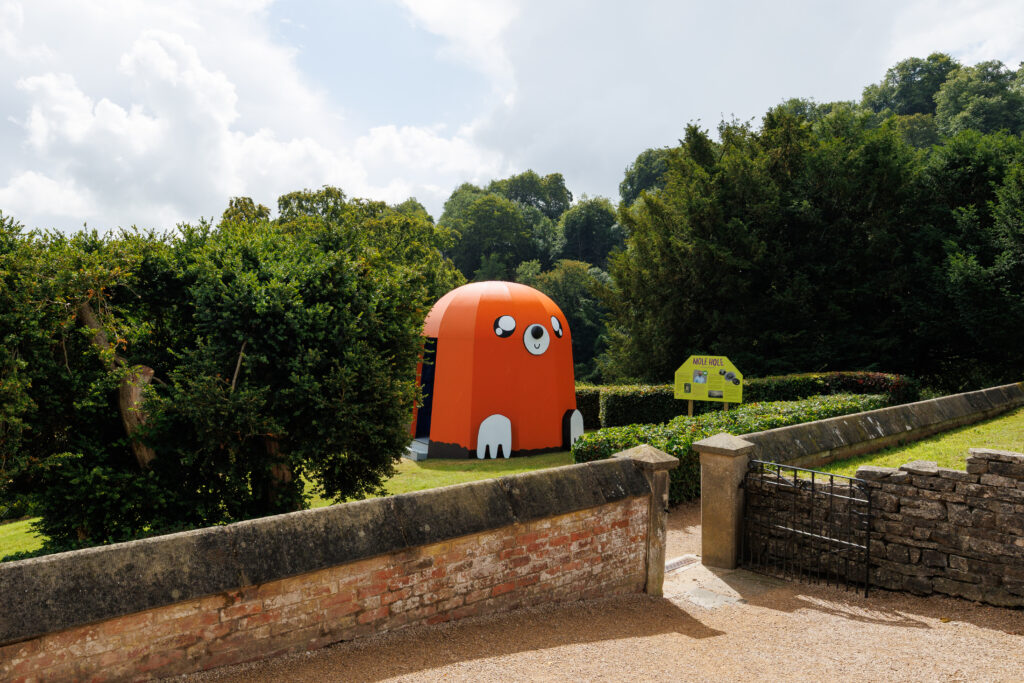
Like much of Bruce Asbestos’s recent work, consisting of large scale inflatables that depict cartoonish characters like the Hooboos, Mega Bunny and Egg Cat, ‘Pepperpot Mole’ has an obvious appeal to children and visiting families. These characters take some of their design cues from children’s books like Roger Hargreave’s Mr Men or Dick Bruna’s Miffy, or the many character products made by companies like Sanrio, most famously Hello Kitty, Pompompurin and Keroppi: the cute plushie toys and merchandisable product lines endlessly generated by international juggernaut franchises like South Korea’s Pinkfong and Japan’s Pokémon are equally influential here. ‘Pepperpot Mole’ introduces a few new elements to Asbestos’s existing parade of inflatables, in its scale, its solid painted plywood construction and its functionality as a working shelter, with an inviting deep blue shaded interior, but the mole itself fits right in with its various inflatable predecessors.
Yet for all the surface level accessibility of ‘Pepperpot Mole’ and its ever expanding cast of companions, there is something subtly off or potentially unsettling about Asbestos’s versions of these quasi-corporate character designs. With their variously glum expressions or forced, uncomfortably happy faces, slumped or overly assertive postures, not to mention existences detached from any known backstory or justifying IP, they reflect a certain ambivalence about the precise nature of these superficially cosy but insanely profitable avatars of innocence and childish joy. Even as they embrace their own ambivalence however, these characters are clearly lovable and their frequent deployment in the context of family and children’s programming at galleries and other art institutions has provided plenty of evidence that they work in precisely this way for such audiences. Put simply, children love them. But perhaps they can also be viewed as objects with a sometimes dual nature, in ways that another National Trust commission this summer makes clear.
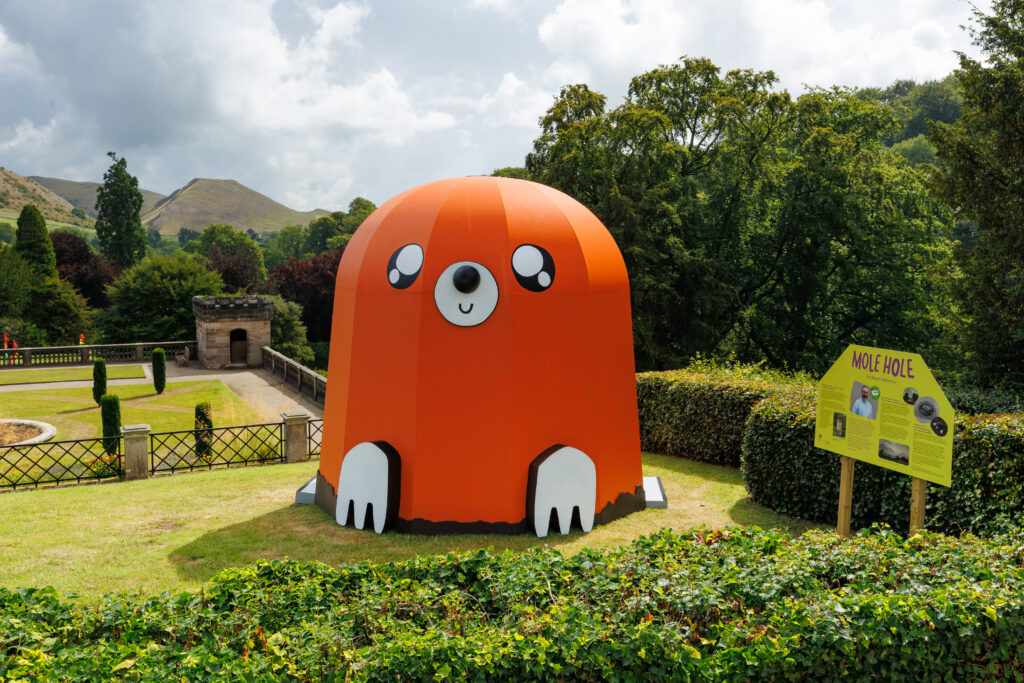
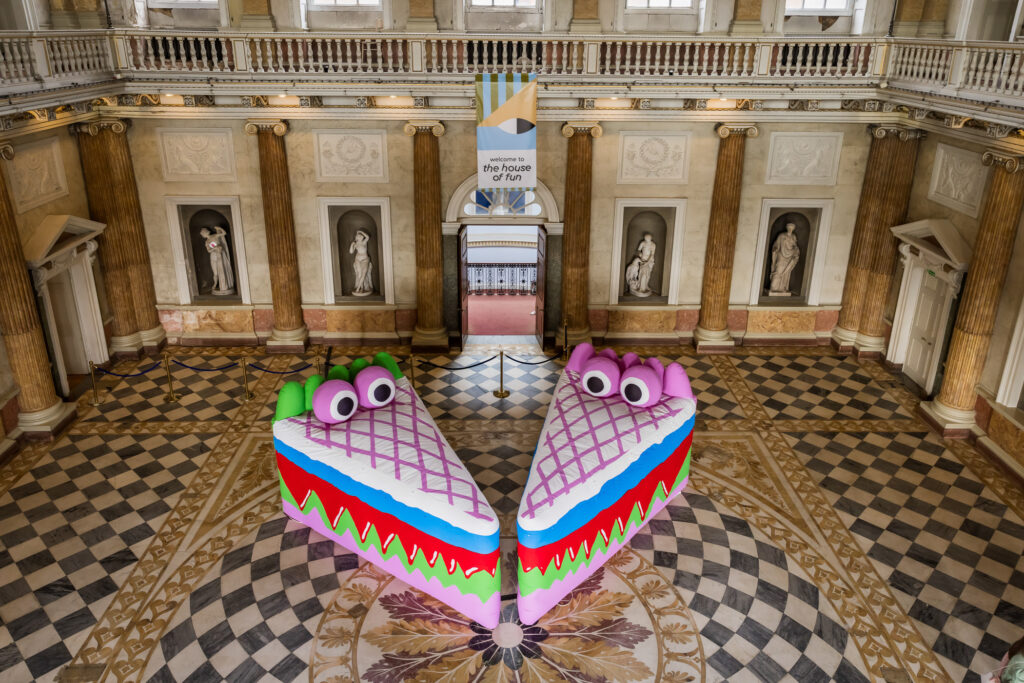
In the lavishly decorated interior of the National Trust property of Wentworth Woodhouse, near Rotherham, a pair of what can only be described as ‘cute shark or maybe alligator cakes’ are set to eye up visitors with teeth bared, like a couple of renegade antagonists from a Super Mario game suddenly transposed into the real world of an intricately decorated heritage interior with an ornate checkerboard floor – as though a pair of cartoon villains have been set against a sixties Bridget Riley Op Art painting. Consisting of inflatable cake slices with prominent eyes and jam-red crimson teeth, fabricated at a slightly intimidating scale, ‘Final Boss’ (2025) could be argued to contain an explicit suggestion of consumer capitalist critique in the work’s obviously, if comically, predatory appearance.
Asbestos himself notes that his inflatable duo – and the Wentworth Woodhouse interior they occupy – reminded him strongly of the kind of cutesy ‘boss rooms’ encountered in the various iterations of Super Mario, where players must defeat a particularly challenging antagonist of one sort or another to reach the next level of the game. Whether we choose to take this as a literal pop cultural resonance, (as those familiar with the games themselves might), or read it as an element in a sly critique of consumer capitalism, (as viewers more familiar with the histories of pop culture and the strategies of contemporary art might), is left entirely up to us. The point isn’t forced.
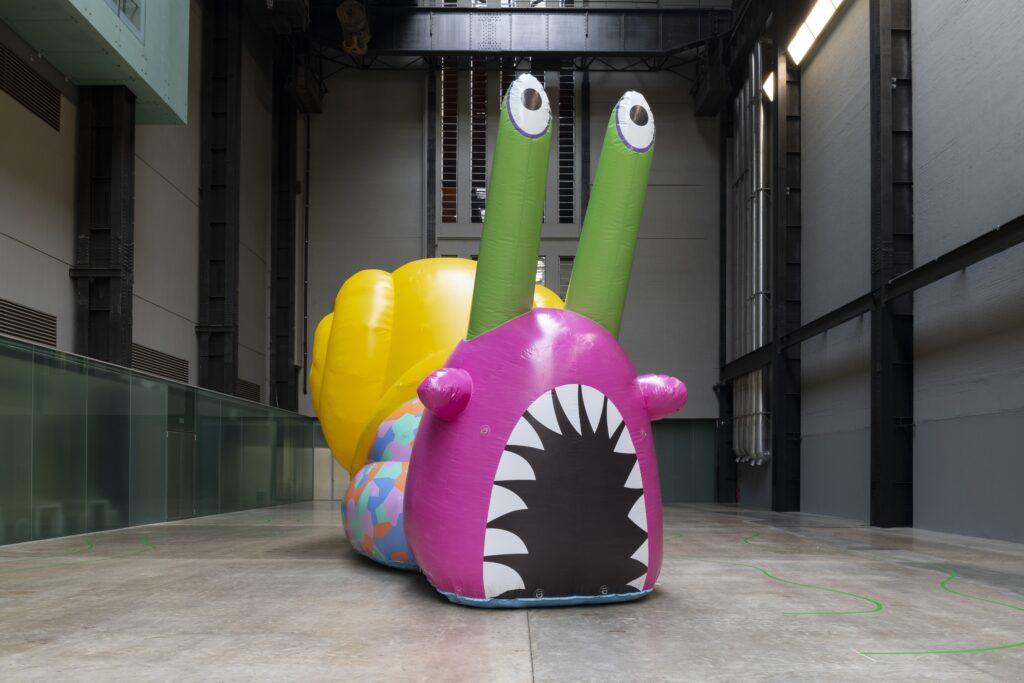
Even so, for Asbestos it is evident that there are a couple of decades of thinking about pop culture and the histories of Modernism and contemporary art informing these works. A recent commission for the UNIQLO Tate Play series in the Turbine Hall at Tate Modern resulted in ‘Dash’ (2025), a large scale inflatable snail, again with some comic but pointedly prominent teeth. ‘Dash’ was made partly in response to Henri Matisse’s ‘The Snail’ (1953), an iconic modernist work, arguably one of the most famous in Tate’s collection, and partly as another character in his ongoing series of inflatables. When ‘Dash’ was displayed in the Turbine Hall back in April it shared the location with Louise Bourgeois’s ‘Maman’ (1999), the largest in her late series of gigantic black spiders, with which Asbestos’s creation appeared to forge a briefly common purpose: a brightly coloured, unruly cartoon offspring to her looming sculptural presence on the walkway overlooking the space.
That these allusions and connections span both popular culture and contemporary art seems to be the inevitable outcome of a life and body of work that has always been steeped in both. As Asbestos has stated himself, ‘the idea of work that references popular culture is of less interest than work making an attempt at being or becoming a kind of popular culture in its own right.’ There are obvious resonances with things going on in the realms of social media, gaming, Korean and American animation or comics and (self-evidently, of late) Japanese Sanrio merchandise, but Asbestos’s work has tended to develop through a kind of voracious immersion in all of these things. Rather than a conceptual gesture predicated on differentials in cultural status, like Andy Warhol appropriating soup cans or Roy Lichtenstein’s use of comic book panels as the material for respectable forms like painting, Asbestos seems more inclined, if also ambivalent, towards the approach exemplified by Takashi Murakami back in the early 2000s, with his seamless ubiquity and glides between the art and commercial design worlds, the limited edition and the promotional toy, the gallery wall and the Kanye West album cover.
Asbestos once theorised all this as ‘Flat Culture’, a realm where art could take any form and appear on any platform, but over the last few years, he’s become less sure that contemporary art is still the most viable or productive realm for him to operate in; noting that the kinds of context and framework – not to mention the support structures and funding possibilities – that he first emerged into from art school twenty-odd years ago seem to be almost entirely gone.
‘I keep wondering – is contemporary art dead?’, he explains. ‘The structures of the art world as I think we knew it are crumbling, that whole framework for making work seems to be mostly dead or dying. I’m thinking of how thin some of the neo-Pop stuff shown in galleries and at art fairs is now’, he adds, ‘…and how blurry the line has become between actual pop culture and the older idea of art. You get someone like Beyonce drawing on work by an artist like Pipilotti Rist in her videos and it can seem very close, except that the budgets and financing behind the pop side of that are so much greater, meaning that the actual art can’t compete. Everything becomes content, pitched at algorithms, which doesn’t leave much room for the interesting, small-scale, slightly weird stuff that is almost always where new ideas come from.’
Perhaps it’s symptomatic that Asbestos’s long term involvement with curating wrapped up its operations a few years ago. Trade Gallery was first established in 2008 in Nottingham’s Sneinton area, where artists like Ruth Beale, Stuart Sherman, Rachel Maclean, Pil & Galia Kollectiv and Bank, showcased work at the now defunct One Thoresby Street studio complex with an emphasis on film, live performance and digital intervention. In its later years, from around 2016, Trade Gallery operated on a smaller scale, out of a room in the artist’s own studio at Primary, a visual art space and studio complex in a former primary school building on the Radford side of the city. The move marked Asbestos’s low key curatorial pivot into painting, drawing and object-based exhibitions by artists like Urara Tsuchiya, Cara Nahaul, Daniel Sean Kelly, Alex Xerri and Sooim Jeong.
By his own admission, Trade’s programme at once followed and informed his own particular interests in contemporary art, and his approaches shifted over the years from projects like the YouTube TV series Social Media Takeaway (2013), a kind of celebration of the early potential of social media as a medium for art, to an ongoing series of live, digitally animated and often very hand made and participatory fashion catwalk shows, built around a variety of themes. These launched with a Hansel & Gretel themed performative catwalk show at Nottingham Contemporary in 2018 and have appeared in a range of venues and formats at regular intervals since: Asbestos staged his most recent, loosely snail-themed, participatory catwalk show alongside ‘Dash’ in the Tate Modern Turbine Hall in April.
Painting, another of Asbestos’s interests reflected in Trade’s programme, continues to be a presence in his work, from the making of self contained images, and the deployment of paintings as elements accompanying fashion shows or displays of inflatables, to a source of material and imagery for reconfiguration as saleable merchandise. A toothsome edition of fluorescent green croc socks (that may or may not be sold out by now) were derived from a joyously slapdash painting of a crocodile back in 2021. T-shirts of inflatable characters like Hooboo and Octopus, are available, with very appealing prototype plushie toys in production of two more: Hooboo and Mega Bunny, already extant at his studio, and set to be available for purchase at some future point. Asbestos’s summer 2024 exhibition at Nottingham’s Djanogly Gallery, Monster Fun, even included a bespoke, fully stocked and functional merch shop.
I visited Asbestos’s studio while ‘Pepperpot Mole’ was under construction in early July. The walls were lined with large-scale bubble-wrapped paintings of cartoonish cats, colourfully abstracted wigs and at least one monochrome line painting of a slightly misshapen figure. Asbestos’s curatorial interests, as made visible in Trade Gallery’s programmes, retain a presence in the work he’s making today, albeit with new spins and perspectives.
Perhaps one driver of these recent changes has been the onset of parenthood and middle age, at least one part of that equation bringing a greater emphasis on having fun and not worrying so much about how the work is seen by the standard measures of the art world. Another might be the necessary adjustments that have been required to continue working in the contexts that artists have been forced to navigate through the long years of disinvestment and safety net removal that have only accelerated since 2008. The perfect destructive storm of 2020 onwards that has not only prevailed for now but seemingly consolidated itself as a brutal working norm for the foreseeable future, has made none of it easy.
‘I’m not sure at the moment if I’m still trying to be an artist, or really just trying to get away from art and become something else altogether,’ Asbestos explains. ‘Maybe contemporary art isn’t really dying, and things will change, and something new will emerge, but we’re not there yet, and I don’t know what that might be or what form it could take.’ Perhaps those predatory cartoon cake slices in ‘Final Boss’, and that benignly emergent ‘Pepperpot Mole’, offering shelter from the ever more unstable climate as best it can manage, are just two further stages in this process of diagnosis: provisional and unpretentious, answering to questions about art’s potential value and purpose in a cultural and economic landscape undergoing tectonic shifts.
Mole Hole: Pepperpot The Mole is on at Ilam Park until 2 November
Final Boss is on at Wentworth Woodhouse, 5th August to 16th November
Wayne Burrows is a writer based at Primary, Nottingham.
This feature is supported by Bruce Asbestos.
View Pepperpot The Mole & Final Boss: Bruce Asbestos’s Pop Cultural Follies on Staging - Contemporary art and writing in the North and Midlands of England
]]>View Who Wants Flowers When They Are Dead? at Williamson Art Gallery and Museum, Birkenhead on Staging - Contemporary art and writing in the North and Midlands of England
]]>
Loss is something that most people will experience – so goes the idiom about death and taxes being the only certainties in life – but in the UK we are not very good at talking about it, with a third of people, according to one of the bench plaques, admitting they don’t speak about their grief due to the worry of upsetting others. The benches that bear these brass plates have been created from the flat, rather uninviting forms of the gallery’s regular seating. These have been reworked by local artist duo Paddy Gould and Roxy Topia into hybrid creations, with the varnished wooden backs and arms of park benches, making them more accessible, and turning them into places where people might actually want to sit awhile, indicating the close attention to visitors’ experiences and access needs that permeates the exhibition. The first thing you encounter on entering the gallery is a pegboard offering different ways to navigate the show including activity cards for engaging with artworks, and headphones for a gentler sensory experience, available upfront to anyone who might like or need them.
The durational nature of grief is touched on throughout the exhibition; the way it seems to change the fabric of a person, clinging to the bereaved; its ebb and crashing flow. ‘Light on the darkest days’ (2023) by Scarborough-based artist Jacqui Barrowcliffe is an artwork consisting of hundreds of small oblong cards, tinted various shades of blue, like paint swatches, displayed in a grid on the gallery wall. They are cyanotype prints, which change colour when exposed to sunlight. Instead of capturing an image, these prints are a record of climate and time passed, ranging from barely coloured to inky navy. They have been created during daily walks during which the artist would pause on a bench and look out to sea, a ritual to seek moments of peace while wrestling with grief. Displayed together, they are a visual document of this period in the artist’s life. Barrowcliffe invites the viewer into this setting, placing a bench in front of the prints, arranged by shade to recreate the blue horizon.

Multidisciplinary artist Jessica Loveday also turns to nature to try and unpick grief, in the wake of the loss of her mother. In her poetic film ‘In this tidal place’ (2025), Loveday walks across a salt marsh carrying fabric sculptures, printed with arcane blue shapes that reference a family heirloom. These are displayed in the gallery, but come alive on the adjacent screen as they move with the breeze across the flats. Steadily, meditatively, the artist narrates her connection to the land and how its timeless qualities allow space for memories to surface. The camera lingers on the rippling tidal pools and blowing grasses of this semi-solid landscape. Addressing her mother directly, Loveday reflects that when she is here, ‘the boundary between us is thinner’.
A pair of disquieting short films on monitors from Cuban-American performance artist and sculptor Ana Mendieta’s ‘Silueta’ series demonstrates the late artist’s physical and spiritual connection to the land. These are the only pre-21st century works in the exhibition, pointing to her influence on later generations. The shape of Mendieta’s body, arms raised to the heavens, is forged into the landscape through ritualistic performances; in ‘Anima, Silueta De Cohetes (Firework Piece)’ (1976) it stands, picked out in fireworks that burn red against the night sky, while in ‘Alma Silueta en Fuego (Sileuta de Cenizas)’ (1975) it lies flat, a white shroud that catches alight before it is rapidly engulfed in flames, conjuring the presence of something ancient, powerful and unnerving.
In ‘Earthing Up Ghosts’ (2025), socially engaged artist Emily Simpson uses her own creative process to hold a space for others. This is another work rooted in nature, here the more domestic environment of her father’s allotment, a space she continued to care for following his death. A table in the gallery space is draped in a patchwork tablecloth that is stitched with panels in earthy greens and browns. These depict the shapes of leaves, seeds and tendrils, and phrases such as ‘tending to grief’, connecting the processes of gardening and dealing with bereavement. The table is intended as a communal space, open to conversations around grieving; Simpson will facilitate a pickling workshop during the exhibition’s run, using practical skills as a tool to unlock feelings that can be difficult to share. Offering the choice of how much or little to participate, and opening a way in, is in keeping with the exhibition’s ethos.
Inevitably, and perhaps by design, visiting the exhibition stirs thoughts of personal losses. I recalled my mum, who died when I was fourteen; she was forty-eight, and I loved her very much. It’s rare that I see depictions of grief that chime with my own experiences. The raw hurt that pours freely in films and TV series sat dumb as a stone for me; I hated the extra attention at school and was desperate for things to be normal. I put on some headphones to watch filmmaker Gurinder Kumar’s ‘What makes you?’ (2022-25), displayed on a scratched up little TV-video combi that takes me back to my teens. It is a work about vulnerability, in which people on the streets give vox pop interviews on their fears, struggles, loves, hopes and losses; an adjacent grid of polaroid portraits is annotated with things that make the sitters happy or sad. I joined the video as two teenage boys in turn talked about the death of family members, and it struck me that both began by saying they’d never really talked about this before, their experiences of loss told like confessions.
US-based artist Candy Chang encourages visitors to share a little of their own inner lives with an iteration of ‘Before I Die’ (2011-present), a participatory installation that has been recreated thousands of times by different communities around the world since its inception. Here it is presented as a square of four chalkboard walls, inviting members of the public to complete the sentence, ‘Before I die I want to ___’, by writing directly onto the walls. This confrontation with the certainty of mortality elicits a range of responses, from the anarchic (‘tell everyone I hate to fack off!’) to the poignant (‘see my son’), that will change and grow during the duration of the exhibition. The sharing of feelings is made visible and simple to participate in, however deep the visitor wishes to go. Inside the chalkboard walls is the exhibition’s Comfort Zone, a lamp-lit area with soft furnishings and shelves of zines, designed as a space for visitors to take some time out. I sat in an armchair and read a poem in one of the zines while my toddler ate a rice cake; an uncomplicated, low-pressure moment of niceness.

For me, the difficult feelings associated with grief don’t come at expected moments; birthdays and anniversaries come and go, and sometimes I forget them and feel bad afterwards. But then I’ll feel an ache like hunger out of the blue; it’s a feeling I get sometimes in our local chemist / purveyor of fancy goods, something in the knick knacks in the window. Jasleen Kaur’s ‘Highs’ (2016), a series of works on paper by last year’s Turner Prize winner, captures something of this, the way an object can spark complex emotions. Yellowing pages of a 1990 copy of Auto Trader magazine recall a childhood in which cars featured heavily, a recurring symbol in family photographs and memories. The pages are framed and overlaid with silhouettes of mountains cut from marbled paper, referencing a Sikh pilgrimage to the Himalayas that Kaur took with her father, in collages that treat both ordinary and extraordinary memories with equal weight.
Curator Lizz Brady’s sculpture ‘Doors falling off their hinges are often caused by loose screws’ (2025) is a three-dimensional drawing of the floorplan of her old family dining room, created as a metal framework. At one end an interior door balances precariously, hinges hanging loose, its white paint faintly grubby with everyday homelife. The work recalls a memory from the artist’s childhood: her father’s appearance at the moment when she and her sister broke their dining room door, the kind of small drama that becomes family legend. The title of Johnny Thunders’ 1978 song ‘You Can’t Put Your Arms Around a Memory’ drifted into my head; Brady’s work feels like a defiance of that notion, making an intangible memory into solid metal and wood, graspable, back here in the present. A gorgeous pair of works by Glasgow-based painter Antony Connelly, ‘Nana and Pop’ and ‘Gran and Papa’ (both 2025), also explores family memories, and the ways in which both sets of grandparents shaped his childhood. His paintings are assemblages of styles and subjects; scenes from photo albums, such as a black-and-white picture of a victorious football team, are rendered realistically, while a classic red and yellow ride-in toy car is drawn in childlike lines. Cartoon characters, a fragment of a staircase, a domino, a can of lager, all float on the canvas, a jumble of scrappy, affectionate memories.

Grief isn’t only quiet remembrance, however. Sometimes it rages, particularly when a loss feels unjust; a life cut abruptly short, or precious time filled with suffering. The exhibition’s title, Who Wants Flowers When They Are Dead?, snaps back at a perception of softening the starkness of death. Artist and writer Dolly Sen’s ‘The Fabric of our Fury’ (2025) is a large-scale collaborative textile work inspired by the embroideries of Lorina Bulwer, a woman incarcerated as a ‘lunatic’ at Great Yarmouth Workhouse for a number of years until her death in 1912. There she created lengthy needlework samplers, in capital letters and devoid of punctuation, filled with protest, anger and indignation. For this homage to Bulwer, which hangs in brightly coloured patchwork lengths down the gallery walls, Sen collaborated with more than twenty fellow women needleworkers to voice fury through stitched texts at contemporary injustices, many associated with disability and ill health: the intrinsic failings of PIP, ineffective politicians, and seething frustration at being patronised. Amy Mizrahi, a painter based in Liverpool and Manchester, explores her personal experiences of illness in ‘A Little Bird Told Me So’ (2025), a surreal self-portrait inspired by a dream. Features such as the bird on her shoulder, and the wooden box of jewel-coloured fish on the table, are painted with thin, multicoloured lines like a carefully worked illustration, giving the scene a fairytale quality. In the painting she sits naked; part of her left leg lies next to her on the floor, replaced at the knee with a fish. In her accompanying text, Mizrahi refers to this transformation as a kind of ‘healing’, coming to terms with the loss of her former self through chronic illness.
The personal loss that can accompany motherhood is explored in a number of artworks in the show; an experience usually associated with new life can signify a seismic loss of self, and subsequent rebirth, for new mothers. Artist and mother Sophie New’s installation ‘The First, Second and Third Stages of Labour’ (2025) presents a CTG machine, used to monitor baby and mother during labour. Rather than heartbeat and contraction data, its paper feed, trailing onto the floor, is filled with sketches depicting the overwhelming first days of motherhood: nappy reports, miniature milk bottles, feeding schedules and so much unsolicited advice. New’s giant sculptural tower of toast, ‘The Fourth Stage of Labour’ (2025), stands as a monument to the fabled regenerative properties of the stack of NHS buttered white toast offered to many new mothers. Fellow artist-mother Marcelina Amelia’s ‘Oxytocin Killed My Shoes’ (2024) is a memorial to the footwear that no longer fit her after childbirth; chemical changes in pregnancy relax the foot’s structure, which often never recovers. Her boots and shoes are captured in monochrome photographs and transferred to tiny oval porcelain plates. These are mounted on the wall like portrait miniatures; the items memorialised before, we are told in the catalogue text, they were ritually buried in the earth by the artist.

Who Wants Flowers When They Are Dead? explores grief in all its multiplicity and knottiness, much more than there is space to tell here. While taking in the artworks, I thought about how we are encouraged to ‘sit with’ our feelings these days; a concept that was alien to my teenage years, and something that definitely takes practice. The exhibition offers a space for this; lots of actual, accessible sitting space in which to dwell, but also multi-faceted perspectives, and a choice of ways in which to engage. It handles the perplexing subject of grief with sensitivity and curiosity, offering no easy answers where there are none, but laying it out carefully for contemplation, and maybe even a conversation.
Denise Courcoux is a writer based in New Brighton.
Who Wants Flowers When They Are Dead?, Williamson Art Gallery and Museum, Birkenhead, 25 July – 13 September 2025.
This review was supported by Broken Grey Wires
View Who Wants Flowers When They Are Dead? at Williamson Art Gallery and Museum, Birkenhead on Staging - Contemporary art and writing in the North and Midlands of England
]]>View Going Back Brockens: Monuments and Rhetoric After the Miners’ Strike on Staging - Contemporary art and writing in the North and Midlands of England
]]>A central area has been created within the space by a timber and board structure spanning concrete pillars, looking a little like building site hoarding. It displays forty acrylic paintings by Price, small and medium canvases that depict present-day locations in former mining communities across County Durham. Devoid of people, they feature details which repeat across canvases, including brick walls, garden fences, windows, desire lines, roads and the sea. Skies are often grey but are sometimes blue, indicating some sense of time passing. Mostly, though, the painted scenes feel suspended in the melancholy of a Tuesday afternoon in November. They number forty to mark the years passed since the 1984-5 miners’ strike.

The exhibition subtitle, then, could be somewhat ironic. Are some scrappy trees, layers of worn away bricks and silhouetted barbed wire all that’s left to memorialize the loss of industry in these places? ‘Like Black Diamonds’ (2025) seems to depict an actual commemorative structure, a black column with a plaque in front, backlit by low winter sun. Juxtaposed as it is with a distant pylon it appears incidental; it could well be street furniture. There is something monumental, though, in ‘They Chased People Through People’s Houses and Gardens’ (2024), in the way a gable end wall seems to square up to the edges of its 90 x 110cm canvas. It displays its sandy yellow and red render like armour. Making marginal details feature centrally like this is a simple gesture to counter the idea of these places as overlooked, it asks for them to be witnessed.

Price’s use of paint in the series also obscures quick legibility. Images come together through inky washes of colour, flat opaque blocks and occasional greasy daubs that sit on the surface. Renderings of light between trees, which up close appear laboured, settle when seen from a distance – only it is sometimes difficult to step back sufficiently within the display as there isn’t enough space. The sheer number of paintings seems to invite a sequential, up-close viewing. Helpfully, this rhythm is disrupted by apertures. As paintings straddle rectangular gaps between boards, their scenes echo the odd empty spaces around the shopping unit, like glimpses of large concertina-door goods lifts, or a handwritten sign hanging from a pipe that reads ‘Paperware and Cereals’. In a recent interview with NARC Magazine, Price described the experience of navigating villages that have been shaped by mining, saying, ‘The whole landscape is hunkered around a void.’
The paintings’ quiet assertion is different to the communicative urgency of the union banners marched each year at the Durham Miners’ Gala. Two contemporary examples of these are presented outside the display structure, leaning against a wall next to a drop-in any-age engagement activity. Artist Jamie Holman’s ‘Above, Below, Beyond’ (2019) banners combine text, motifs and images rendered in shimmering silk as part of a project which was developed and co-created with communities in East Durham, the banners connect acid house references to the Gala’s collective visual narratives of place, pride and struggle.

Voices broadcast from speakers mounted high on the concrete pillars add to the exhibition’s layered experience. During his time living in Horden in the early nineties, Hudson conducted interviews to document the impact of its colliery’s closure. These recordings, played here publicly for the first time, later became the foundation for his book Coming Back Brockens: A Year in a Mining Village, which lends the show its title. The sound installation is not a voice-over. Mostly, it has an understated presence, acting as an ambient score marked by tone, accent and the age of the recordings. Phrases come in and out of focus, sometimes with gut-punch clarity as with the words ‘four hours and twenty minutes…I thought I was going to die…’. Price’s titles carry other fragments of language from this archive. Some, like ‘But the Burden…’ (2024), evoke a heavy inheritance; others, like ‘I Could Feel the Boots’ (2025), give vivid sense images. ‘You Don’t Know These Things’ (2025) and ‘It Doesn’t Work That Way’(2023) speak of the complexity of articulating history. A reminder, even with stories that have been frequently told, of the importance of going back to source.
Carl Joyce’s short film series Where We Belong (2025), produced as part of wider engagement work in the development of Going Back Brockens, continues in this vein. Across two projections, with seating, wireless headphones and plenty of space around them to dwell, the series presents six individually-titled portraits of people from former mining communities. Each is driven by its subject’s voice, which is heard over footage of them in the places they are speaking about, often shown in slow motion. The framing of location details recall, and sometimes directly reference, Price’s paintings. Drone footage and archival film footage of mining activities provide other textures.

The films’ meditative pacing means expressions of hope and despair are given equal space to breathe. In ‘Fractured’ (2025), former National Coal Board catering staff Pamela speaks of her home village of Murton’s permanent breakdown of community since the strike and the government’s response. Despite this, she adds, without any sense of empty platitude, she will always love Murton. Author Pip Fallow makes a stark call in ‘Healing’ (2025). Even if ‘left-behind’ places are the result of intentional neglect by governments, he asks them to ‘bury the hatchet’ for the sake of future generations. ‘Resilience’ (2025) focuses on Joseph, who moved to the coastal former mining village of Horden from Nigeria three years ago. He articulates the complexity of loving the place he moved to, to secure his family’s future, and recognizing what he calls ‘the retrogressive journey’ it has been on since the pits closed.
Anniversaries invite retrospection. Reaching round numbers like forty, we might assume narratives should be resolved. After this staging at The Warehouse, the show travels to the Durham Miners’ Gala where Price will speak on stage and the show will be installed in the Redhills Art Tent. After that, it travels on to Horden for its one hundred and twenty fifth anniversary celebrations in August, in a homecoming for the voices who contributed to Hudson’s original book. In Going Back Brockens, different elements of the story are allowed space to interact and for new meanings and effects to emerge – significantly, with the communities that shape it at the centre.
Kate Liston is an artist and writer from Gateshead.
Going Back Brockens: Monuments and Rhetoric After the Miners’ Strike was open at The Warehouse, run by MINE (Made in the North East) collective, 13 June – 5 July. It was shown in the Redhills Art Tent at Durham Miners’ Gala 12 July. It will be installed at St Mary’s Church in the village of Horden 22 August. The exhibition will be staged at Sunderland Museum & Winter Gardens 12 September 2025 – 3 January 2026.
This review is supported by No More Nowt.
View Going Back Brockens: Monuments and Rhetoric After the Miners’ Strike on Staging - Contemporary art and writing in the North and Midlands of England
]]>View How to Build a Village (for Artists) on Staging - Contemporary art and writing in the North and Midlands of England
]]>That “inclusive growth” will see the only existing artist studio space in St Helens demolished. Platform, an artist-led space situated in St Mary’s Market, a central and sprawling indoor shopping centre, has been home to twenty studio members over the past thirteen years. At present, Platform is at capacity, with six artists calling the space home and a long waiting list to join. This is one of the reasons Weetman and Collins have been advocating for more studio space to be made available since 2019.
Last year, Weetman and Collins responded to an open call out from St Helens Council that asked: What are the needs of creatives based in St Helens (specifically around studio space and resources)? To tackle this question, they proposed a participatory action research model, building on their experience of running Platform Studios (co-founded by Weetman with other local artists in 2012) and advocated for the inclusion of studio space within the town centre regeneration plan. Collins perceives the council as having positioned them as the voice “representing the art community”, but believes the response to regeneration must be collaborative. Therefore, their research has included working with 99 local creative individuals and organisations including The World of Glass, Cafe Laziz, Buzz Hub St Helens CDP, The Book Stop, STAT magazine, Corridor8, St Helens College and University Centre St Helens. The outcome is two beautiful short films[1],[2], three reports (publicly available from late August 2025) about artist’s studios, equipment and resources, and a ‘toolkit’ document to support artist development. It’s called How to Build a Village: Artist-Led St Helens, and it’s both thoughtful and thorough.

The Findings
For readers unfamiliar with the town (and I was largely, until starting a job at a St Helens based NPO three years ago), let’s set the scene:
A former mining town, and famous for glassmaking amongst other heavy industry, St Helens boomed during the Industrial Revolution. Part of the Liverpool City Region, and with a population of around 117,000, the town is probably best known for its successful Rugby League team the Saints, the World of Glass museum, and Jaume Plensa’s Dream – a huge, 66 foot public artwork visible from the motorway. Or you might have heard of local legends Rick Astley and Johnny Vegas?
St Helens scores high on national deprivation statistics, perhaps due to an increasingly elderly population, than typically found across the North West. According to the 2021 census, 22% of people in St Helens identified as disabled, and the town also had the region’s joint highest proportion of people (aged five years and over) providing up to 19 hours of weekly unpaid care.
These statistics are important because they intersect with the real lived experience of many artists in St Helens, who told Weetman and Collins that one of their primary needs is studio space close to home.
Another key strand of the participatory action research model was to work with the artists in the town to see what a shared studio space could look like, based at Street and a Half, leased to Artist-Led St Helens by Kindred and managed by Make. In St Helens, Kindred’s remit is to bring buildings back into community use (something Make have a lot of experience with in Liverpool’s North Docks, Birkenhead and Huyton), and Street and a Half promises to be a space for creatives “to test out new ideas and encourage a creative community to flourish”.
I met with Weetman, Collins and some of the artists that have supported their research in the Street and a Half space to chat. The tension between gentrification and grassroots arts activity is palpable as we discuss the varying needs and wants of the council versus the community, and I’m reminded of the ever-changing spaces’ former occupants: it’s the space where I started my role with arts organisation Heart of Glass, and before that, was an independent called Mash Café.

Street and a Half has proved to be a less than perfect venue; issues with the lease meant that access to the building was limited, and so during the three months they hoped to run an accessible studio as an R&D pilot project, artists could only access the space a day a week. This significantly impacted the scope of Artist-Led’s research, meaning the space was used mainly for events and workshops. As if on cue, an artist enters Street and a Half as we chat: he’s setting up for an event later that evening, a very necessary peer support group for artists working on their unfinished creative projects.
The space has seen forty days of activity (five events and twenty workshops) in total, including: three days of research and consultation, a BA Fine Art Painting student residency, Reverse Realities painting workshop with artist Jasmine Lockett, KLASS a pop-up design shop by BA Graphic Design students from St Helens College, and Expressions of Tomorrow exhibition by Level 3 Art and Design students at St Helens College. One day a week, artists and freelancers used Street and a Half as a co-working space. But they could have done much more, given the permission. It’s clear from our chat that St Helens is really lacking in not only arts spaces, but places that feel multicultural, queer or politicised. A sentiment that is borne out in the data collected by Artist-Led St Helens. Plus, as well as thinking about visual artists, the team’s next event programme will pay close attention to the needs of musicians and performers – artists for whom rehearsal space is precarious or lacking in St Helens too.
Street and a Half stretches the length of the street: “a live feasibility study to establish the demand, and potential, for space in which creative and social businesses can gather and grow” (Kindred Press Release, 2024). The new space is designed to support and nurture social businesses and start-ups “from recycling fashion projects to cake-making businesses looking to employ local people” as well as artists, designers and makers looking for studio space. It’s a broad remit, and risks forgetting about the artists and the space they so sorely need.
Space to separate artistic work from care work, and other life responsibilities (which many of us who work remotely can relate to). Space to create: artists need room for their projects, and it was noted that being cramped in a bedroom or on the kitchen table can and will have an impact (or even creative limits) on artistic practice, for example, forcing the individual to create smaller or perhaps digital work. Space contributes to a sense of professionalism too – from hosting clients to student gallery visits, artists deserve to take up space. The space at SnA feels like a great starting point, but it’s not guaranteed.
A lot of space is also needed for storing and sharing equipment (details of the equipment artists are asking for were shared with the council as part of Artist-Led St Helens work). Sharing spaces and resources in turn helps foster a sense of community – another thing that artists found lacking in the town at present.
From the report: “Attendees valued the sense of community, support, and connection the events fostered. They appreciated the opportunity to collaborate, share knowledge, and build networks in an environment that felt welcoming, friendly, and useful for their creative direction. Overall, the events were experienced as catalysts for personal growth, community-building, and positive energy.”
Right now, a lack of studio space poses a direct threat to any sort of artist community even existing in St Helens. If it’s not available in the town, artists can and will move elsewhere, and the possibility of creative community will be lost. It feels like a civic responsibility.
“As a disabled person I feel like the studios at SnA are a hub of inclusivity and neurodiversity, and it’s a friendly non-judgemental place” Writer Joseph Hughes tells me. “It’s part of why I’ve changed in the past year or so from wanting to move out of St Helens at the earliest opportunity to wanting to stay here.”
What does Affordable mean?
Many people stay in St Helens because of care responsibilities and generational poverty. Collins returned after completing their university course in London because for them, St Helens is “imperfect, but important”. They love the affordability of living here, and don’t want to be in London “chasing someone else’s idea of success, trying to reinvent themselves or be cool.”
So affordability is key to a sustainable model of artist studio in St Helens. But affordability is complex and Artist-Led St Helens note they “wish to fully understand what ‘affordable’ means to practising artists in St Helens at various career stages.” Affordability is a sliding scale – most artists earn less than minimum wage. The last large scale report of artist income reported artists earn £2.60 per hour, whereas minimum wage is £9.50 (STRUCTURALLY F*CKED, 2023). Affordability means to be both sustainable, and value for money.
Weetman and Collins found that artists in St Helens typically expect to pay less than £100/month – “We believe the initial creation of a low-cost (under £100 per person) shared studio space, with a sliding scale approach to pricing and a shared hardship fund, would promote St Helens as a cultural town and strengthen the creative community.”
Right now, “there’s a sense of artists “passing through St Helens on their way to be creative” Joseph muses, as we confront the idea of internalised class prejudice. “They’ll be back” Collins playfully retorts. They admit that they see part of their role to bring artists to St Helens, and Joseph adds: “before this, I wanted to get the first train out… the fight to stay isn’t one I have to do by myself now”.

“St Helens Artists Need a Shared Financial Model”.
Liverpool based artist Josh Coates recently received funding to visit New York to research Community Land Trusts, and has been sharing his learning with Artist-Led St Helens, as they ponder how to move forwards. “Radical use” (in this case referring to a non-hierarchical artist-run space) “has to be filtered through business / capitalism” he shares. “We want radical land ownership (community ownership and redistribution of land to address historical injustices and promote social and economic equality)… whilst selling keyrings” (a reference to a recent pop up in the Street and a Half space). Places like Wiese in Hamburg have managed this – an artists studio propped up by income from a café and nursery on site, however, there aren’t many examples of places like this being run by working-class artists. Josh has asked around, and can’t find a single one in the UK.
We discuss the pros and cons of CLTs (community Land Trusts) versus CICs (Community Interest Companies) , their various rights and rules over property ownership and the financial implications that may bring. There’s always squatting.
So the real question is – will St Helens Council listen?
“With the town’s regeneration already taking place, this is the perfect time for St Helens to create a space for artists to work in the town. If artists can’t locate affordable space within St Helens, they will take their creativity elsewhere” – How to Build a Village, 2025.
The report is clear: champion the ideas of St Helens’ community of artists and collaborate with them on the town’s regeneration. The changing population in the town is creating more diverse, multicultural communities, and there’s an exciting opportunity to centre artist voices in its future. This sentiment is echoed in a Guardian’s 2015 report on creative ways artists can improve communities (2015): “this movement isn’t about positioning artists as special outsiders who parachute in with easy fixes, but as neighbours who are one part of a whole set of things a community can do to be healthy.”
Building a village for and with artists will be a collaborative process with the “swishy blazer people” (as Collins refers to the council et al), which means interfacing with bureaucracy; perhaps a small price to pay to allow space to create genuine, bold change in the community.
Artist-Led St Helens delivered this research, commissioned by St Helens Council Arts Service, with funding from the UK Government through the UK Shared Prosperity Fund and Arts Council England in partnership with St Helens Borough Council, Kindred LCR CIC, St Helens College, and St Helens Borough creative practitioners.
Sinéad Nunes is a writer based in Liverpool
This report has been supported by Artist-Led St Helens
View How to Build a Village (for Artists) on Staging - Contemporary art and writing in the North and Midlands of England
]]>View Confluences on Staging - Contemporary art and writing in the North and Midlands of England
]]>Confluences begins before you enter Cross Lane Projects, with two rounded, totemic clay sculptures with hollow centres visible from the building’s entrance yard titled ‘Da Fun-fun: Autonomous Resonator Twin’(2005). The clay is calloused; traces of their maker are clear – British-Nigerian sculptor Lawson Oyekan has scored, poked and lacerated them, leaving thin lines and holes across the work. The clay looks like it has dried up, shrivelled and been rehydrated before being slathered with shades of baby blue, pink and yellow pigment – like boiled sweets or rhubarb and custard melted down and smeared on dried earth. An intriguing, tactile start to the exhibition.
In the press release, exhibition curator and gallery co-director Rebecca Scott describes Confluences as a ‘gathering’, exploring the ‘influences and dialogues’ between Mark Woods and ‘the artists who have crossed his path in his years living in London and Cumbria’. Woods is Scott’s husband and her fellow Cross Lane Projects co-director.
Woods and Scott opened Cross Lane Projects in 2018, aiming to bring new and contemporary art to Kendal with exhibitions of local, British and international artists. The exhibition programme over the last few years has included hosting the Mark Tanner Sculpture Award and collaborations with other organisations like the Kendal Mountain Festival. Cross Lane Projects also regularly exhibits the work of Scott and Woods themselves; of the eighteen exhibitions which were not collaborations, fifteen of them included work by Scott or Woods. This perhaps explains why Confluences was not the typical group show I expected.
Working mostly in sculpture and photography, Mark Woods began as a jewellery designer, first exhibiting his erotic, and often grotesque, sculpture and photography in the early 1990s. Indeed, the majority of the exhibition focuses on Woods’ work; Confluences is largely a reworking of Cross Lane Projects’ previous exhibition, Formula + Fetish, a solo show. For Confluences, Scott kept the majority of Formula + Fetish, replacing some works with artists who influenced or were in dialogue with Woods.

Perhaps the most obvious dialogue in this exhibition is between Woods and French-American artist Louise Bourgeois, best known for her large-scale installations. Bourgeois’ ‘I have been to hell and back and it was wonderful’ (1996) awaits us in the gallery’s opening room. The quaint pink handkerchief with its affecting, darkly comedic words sharply clashes with the sickly sweetness of Bourgeois’ embroidery – a traditional craft associated with a gentle femininity. The words are stitched on – imperfect, almost shaky, like a child learning to write and fill the lines of the exercise book – lending a nightmarish, satirical quality to the work.
To the left of this artwork is Mark Woods’ ‘Christmas Neck Piece’ (2024), a similarly cool-toned, small, baby pink work. This wall-mounted sculpture is crafted out of bondage collars and cuffs. Woods’ piece is dotted with silver hardware and spikes, adding a harsh edge to a seemingly cute work. The clash of rosy pink and darker comedy allow Woods and Bourgeois to sit nicely in dialogue with each other. For the visitor more familiar with Bourgeois, however, the connection between the two artists does not stop here. Bourgeois’ vast oeuvre includes many sensual, erotic sculptural works, which, judging by Woods’ photography included in the exhibition appear to be a far stronger influence on him than the framed handkerchief on display.
Wedged into the corner of the first room is, a vintage wooden carousel of picture frames holding a series of Woods’ photography. The intriguing display system forced me to confront each photograph intimately, my hands grabbing the edges, fingers grazing the glazing as I peered into each frame. I was uncomfortably close to this disturbing set of photographs. In one photograph sits a headless female mannequin suspended by rope; her khaki jacket is left unbuttoned and spread. She wears a white top with the teats of a baby bottle in place of her nipples. The mannequin’s articulated legs are spread apart as she appears to receive oral sex from another female figure, who wears an ashy blonde synthetic wig and a large frosty blue frilly dress.
The image is immediately identifiable as both erotic and disturbing. Woods may well have been inspired by Bourgeois and by English artist Sarah Lucas (a figure notably absent from this exhibition), who is best known for her surreal and humorous sculptures. Woods’ staging of a suspended mannequin feels reminiscent of Bourgeois’ well-known voluptuous surrealist female forms like her ‘Cell XXVI’ (2003) where she presented a suspended body twisted into itself using a distorted fabric sack.
In another photograph, Woods captures a bra, pads removed and replaced with elongated breasts – stuffed so harshly they look stiff, with rubber teats sewn into the thick fabric. The exaggerated breasts appear derivative of Lucas, in whose work misshapen breasts are a recurring feature.
Bourgeois and Lucas’ work distorts the female body, with figures effaced, suspended or contorted, and yet they are not as sexualised or fetishised as the subjects of Woods’ work. Lucas uses soft materials like nylon tights filled with polyester stuffing, allowing the breasts to droop and sag, leaving her work to wallow in an aura of exhaustion or humour. The female figure in Woods’ work, however, is much harsher – mannequins staged, sharp forms constructed with nowhere for the material to bulge or expand, no place for the exploration of women’s emotions and desires. In the severity of their construction and the pervasion of a notable ‘male gaze’, Woods’ work seems sensationalist and purposefully provocative, but I wonder how subversive it really is? To quote a certain terrible show that I’m embarrassed to have watched: ‘Check your sell-by date, ladies, faux lesbian kissing hasn’t been taboo since 1994.’ These words of Cheryl Blossom, a melodramatic cheerleader in Riverdale, a deeply American Gen-Z TV show, ring true here. Is there anything subversive about a heterosexual man staging women having queer sex for himself?
In another portrait in the carousel, Woods is hunched over naked, wearing heels and standing underneath the voluminous petticoats of a frilly dress. The image captures a moment of concern and even shame – like a child peering out during a game of hide and seek, wondering when they’ll be caught.
Woods is evidently a provocateur. He purports to be disruptive and provocative, blurring the boundaries of gender norms. On one level, this photograph might capture the difficulty and lack of space for heterosexual men to play with and challenge traditional ideas of masculinity. However, the focus on humiliation and shame seems to inadvertently reify these traditional models of gender. If dressing up as a woman is meant to be humiliating, exactly what is being subverted? This carousel of constant satire, shock, and fetish leaves me wondering what the artist’s intention is. At what point does it stop being satire?
The following space offers some respite as we move into a selection of Woods’ sculptural works. These include a series of vintage Samsonite travel cases. Inside these vessels are intricately designed, monstrous sex toy contraptions. That Woods is a former jewellery designer comes as no surprise; these objects are deftly crafted. Like ‘Christmas Neck Piece’ they are filled with BDSM paraphernalia: beds of fluffy grey curly hair cradle acrylic nails, spikes, lacy underwear and thick black rope.

Above these cases lies London based artist Cedric Christie’s ‘Yellow Curve’ (2012) – an elegant, large-scale steel curve neatly filled with yellow snooker balls. It looks like a pendulum frozen in time. Sleek, elegant, modern, and minimalist, it appears to clash with Woods’ heavily erotic and fetishist work. Like Woods, Christie trained in another industry, first a welder and then an artist. Both artists employ their former trades – Christie drawing on industrial metals where Woods evokes fine jewellery. Both are concerned with form, using deeply intentional shape and construction albeit with vastly different-looking results.
In the following room, Atty Bax’s erotic sculptures punctuate the walls. Like totems, they are sensual, quasi-religious objects, like sacred altars. ‘Captured’ (2022) features a rose-like purse – fabric tufted and folded in on itself with pink trimmings and pearls. The rose sits upon a pink throne with a ruffled lacy skirt, the headboard like an altar piece, with black beads drooping. The folds of the flower highlight this symbol of female sexuality, while the beads and lace lend a baroque sensuality reminiscent of Woods’ work.
The final gallery space of Confluences feels like the gallery stores have thrown up – hungover from a dizzy cocktail of artwork, a strange concoction is left splattered across the closing room. Unidentifiable canvases are stacked leaning against the wall while Gavin Turk’s ‘Habitat (Burgundy)’ (2004), a 70 kg painted bronze sculpture of a sleeping bag, is stranded on the floor. In one corner of this room is a Mark Woods sculpture: a mannequin wearing lacy pink nightwear over a latex suit, with a lampshade over its head. In the opposite corner sprawls Lee Holden’s installation ‘Awkward Silence’ (2005), including rotary telephones, wires, and other dated technology. This room is maximalist and chaotic with this cacophony of work. Scott may have aimed to provoke and shock in her curation of this space but leaves little room to explore the artworks or consider the dialogues the show set out to explore.
Scott describes the exhibition as a ‘gathering’. Indeed, ‘gathering’ is an apt word – Confluences seems much more like a collection of work than a cohesive narrative. Visitors, at times, must work quite hard, or rely on extensive pre-existing knowledge, to understand the connections between Woods and the other artists. In effect, this group show is really a fleshed-out solo presentation of Mark Woods – whose work leaves me muddled and frustrated weeks after my first encounter.
Confluences, Cross Lane Projects, Kendal, 19 July – 13 September 2025.
Vaishna Surjid is a writer and curator based in Manchester.
This review is supported by Cross Lane Projects.
View Confluences on Staging - Contemporary art and writing in the North and Midlands of England
]]>View Uncanny Carnival on Staging - Contemporary art and writing in the North and Midlands of England
]]>The Programme Committee is a group selected every couple of years to work together on projects and exhibitions as a kind of hands-on development programme for artists, curators and organisers who want experience in commissioning or managing projects within the boundaries of an established organisation. Uncanny Carnival is artist and comedian Seymour Mace’s project. His squad of facilitators, helpers and other NewBridge members (including myself) spend the day stewarding, clowning and, well, mucking about. We wear bright pink high vis jackets – mine has a fancy trim and a big shiny ‘Y’ on the back. Before we begin at 11am, we stand in a line so our jackets spell ‘UNCANNY CARNIVAL’, a warm-up for the collaborative effort to come…

‘We are in a big circle of joy,’ says Dan Russell (Artist Development Programmer at The NewBridge Project), as we chat over a packed lunch of sandwiches and a satsuma. The ‘circle of joy’ is a ring of marquees connected by bunting made up of scraps of black, white, red and green patterned fabric, a subtle nod to solidarity with Palestine. When I ask him what it means to have Uncanny Carnival here, in this place, he says, ‘Well it’s a big grass bowl, why not have it here? And it’s near enough that loads of people who we know from Shieldfield can cross the road and come.’
This is important for understanding events like Uncanny Carnival and The NewBridge Project more broadly. Those friends from Shieldfield include crowds of kids chasing bubbles and older folk sitting on folding chairs in front of the stage. There are families from the coast and locals from across the road, which is a rare mixing at an art event. NewBridge has genuinely made the crossover into a community-oriented art organisation. They have real people involved in almost everything they do; real people not being used as material, or to tick diversity boxes, but who come because they like it. And they are properly encouraged to make whatever art they like. Today they are up on stage, rapping and acting out skits. Who of us will ever forget ‘The Bumblebee Song’? Improvised by a small girl (at the encouragement of comedian Elaine Robertson, hosting the tiny stage) it is allowed to reach, via many encores, its (un)natural end – meaning it went on, and on, and on, but had all of us singing along in a kind of trance. This is the spirit of Uncanny Carnival. When they say they want to encourage your creativity, they mean it.

It is a day of pouring rain and extreme sunshine, interspersed with almost gale force winds. Everything is tied or taped down. We are on a grass field surrounded by wildflowers, weeds and urban jungle. Dan points out Heather from Wild Intrigue who planted the wildflower meadow, which has been attracting local species of sand martins back to the Ouseburn. I scan the stadium and see Elvis impersonator David Hall taking photos with the help of his assistant Toby Madison. There’s the bubbleologist Jesse Ward, keeping upwind, music and bubbles emanating from their machine. Mace has worked with a number of other organisations who regularly collaborate with The NewBridge Project, some of whom have set up marquees here, such as The Comfrey Project, a charity from Gateshead that works with refugees, who are making tea bags. Alternative comedy act the Silly Billies are doing Punch and Judy, and as it begins, many of us hold our breath – is it going to be an old school Punch? No, they swerve that – but he’s still awful, because he’s meant to be, and the kids love it. Local art charities that support mental health through art are here: North Tyneside Art Studio are chucking paint balloons at a canvas with artist Beth Stead, and members of Chilli Studios are singing R.E.M. songs with a guitar on stage.
There’s dressing up in the middle, and face painting. There are games that nobody can play properly, things like diablos, spinning plates, hula hoops and boules. They lay untouched on the grass for a while, but the plucky local kids figure out their own games to play with them, chucking them about, skipping around on hoops. If you’re in costume, anything goes, right? A little kid dressed as a Lobster is encouraged to join the fashion drag parade, judged by Seymour in full clown gear pulling a tiny pram full of toys as prizes.
While stewarding the hard-to-play games, and standing innocently twirling a hula hoop, I somehow get heckled into the on-stage banter between Elaine and comedian Lee Kyle, who is wearing a pink wig and speaking in a cod French accent. It feels completely natural to shout ‘OUI’ back at them when they ask me daft questions. I miss most of the drag act Open Drag Collective – I am busy helping the face painter deal with a mile-long line of children – but afterwards I see a kid take their grown-up over to the group of Drag Queens and Kings for a chat. During the drag fashion parade, the performance group Sound Games – four people of varying ages dressed in gothic garb – run behind the stage, blowing horns and hollering gleefully.

It’s not easy organising an event of this scale. It was eighteen months in the planning and involved a number of different partnerships. I’d heard that Seymour had been resistant to the bubbleologist and the face painter, them being the most conventional aspects of the carnival, but I think it would have been a mistake not to have them. There are literally crowds of kids chasing bubbles and screaming with joy. Wearing a red nose and big clown feet, he tells me that, ‘Organisations are often time poor, staff poor, have few resources, and it’s difficult to pull time from something – but hopefully the fact that we’ve pulled this off bodes well for the future. So, people should work together more; there’s strength in numbers, solidarity, and the more that organisations come together in this way, the more support they’ll just naturally give each other. Everyone who stuck it ‘til the end has been really positive and wants it to happen again.’
It is a genuinely canny family day out. A chance for us to let off some steam and be ourselves in this mixed-up crazy world. All free, nothing to buy. There are packed lunches made up for us and any kids who need a snack or a bottle of water are welcome. The giant canvas that began as a dart-throwing-at-paint-balloons game is now completely covered and successfully expresses the theme of the day, which is ‘let go and be foolish, just for a little while’.
And at 4pm, exhausted but happy, we clear it all away. As we are filling the van, the heavens open and we get drenched, but this group of pals haul everything back to NewBridge in the pouring rain still smiling. And then we all go for a canny few pints after.
Lesley Guy is an artist and writer based in Newcastle upon Tyne.
Uncanny Carnival took place at City stadium on Saturday 28 June. Click here to find out more about The NewBridge Programming Committee.
Uncanny Carnival involved sixty artists and partners, including: Beth Stead, Chao Wang, Chilli Studios, Comfrey Projects, Dan Goodman, Dan Russell, David Hall, Dwellbeing, Edi Czarnecka, Eleanor Beck, Elaine Roberston, Ellie Armon Azoulay, Fat Cactus Films, Frances Stacey, Hannah Kirkham, Holly Argent, Izaak Gledhill, Jackie Wood, Jesse Ward, Kaltouma Hassaballah, Lee Kyle, Lesley Guy, Lib Hodes, NewBridge Project & NewBridge Books, North Tyneside Art Studio, Open Drag Collective, Rafael Baggot, ReCoCo, Seymour Mace, Shelly Knotts, Silly Billies, Sound Games, Shieldfield Youth Programme, Stu Edwards, Toby Madison, Unfolding Theatre and Wild Intrigue.
This review is supported by The NewBridge Project.
View Uncanny Carnival on Staging - Contemporary art and writing in the North and Midlands of England
]]>View OUR TURN × Corridor8: Emerging Writer Bursary on Staging - Contemporary art and writing in the North and Midlands of England
]]>OUR TURN is a new visual arts festival taking place between 26 September 2025 – 28 January 2026, in venues and unusual spaces across the city of Bradford. The aim of the festival is to celebrate Bradford’s rich creative scene, bringing together new and established artforms, and supporting artists and audiences at all stages of their creative journeys. Learn more about the festival here.
OUR TURN is supported by Arts Council England and Bradford 2025 UK City of Culture.
The opportunity:
Corridor8 is partnering with OUR TURN to offer a paid writing bursary for an emerging or early-career writer based in the Bradford region.
This is an opportunity to spend time with OUR TURN, attend exhibitions and events (including the festival launch on September 18th), meet artists and audiences and respond creatively and critically through an extended piece of writing. The resulting text (1,500–2,500 words) might take the form of a review, a personal essay, a reflection on place and practice. We are open to your unique voice and any format.
We are especially keen to hear from writers from backgrounds underrepresented in art criticism, or who bring lived experience and insight from outside traditional art writing routes.
What the selected writer will receive:
- A £350 commission to write a 1,500-2,500 word text on an aspect of OUR TURN.
- Editorial support and mentorship from the Corridor8 editorial team.
- Travel costs to attend selected events and exhibitions across the festival, including the festival launch on Thursday 18 September.
- Publication on Corridor8’s website.
- Opportunities to connect with artists and curators involved in the festival.
Timeline:
- Call opens: Tuesday 5 August
- Deadline to apply: Tuesday 2 September
- Writer announced: Monday 15 September
- Festival Launch Event: Thursday 18 September
- Festival period: September 2025 – January 2026
How to apply:
To apply, please send:
- A short statement (max 300 words) introducing yourself and why you’re interested in this opportunity
- One example of your writing (can be published or unpublished, any format)
- A short note on your location and relationship to Bradford.
Send to: ourturn@southsquarecentre.co.uk with the subject line “Writer Bursary Application – YOUR NAME”.
Applications close on Tuesday 2nd September at 12 noon.
Support: If you would like support in completing your submission, please email ourturn@southsquarecentre.co.uk. There is no such thing as a silly question – if you don’t know the answer, we can guarantee someone else doesn’t know it either!
View OUR TURN × Corridor8: Emerging Writer Bursary on Staging - Contemporary art and writing in the North and Midlands of England
]]>View Amartey Golding on Staging - Contemporary art and writing in the North and Midlands of England
]]>At FACT, the sculpture stands alone underneath a bright spotlight in an otherwise very dark room. The chainmail glistens like a pile of costume jewellery. The seating—hardwood benches arranged in two blocks of three rows, with back rests that make it difficult to slouch—are reminiscent of church pews and a deliberate choice that is markedly different to the gallery-standard blocks, cubes and beanbags. Lauryn Hill’s ‘Ex Factor’(1998) and Vera Lynn’s ‘We’ll Meet Again’(1939) are melded together to provide the installation’s soundscape, played on a loop, at half speed. The overall effect is beautiful, haunting and melancholic all at once.
Chainmail 4 is the product of a two-year collaboration in which Golding worked with incarcerated men and prison guards based at HMP Altcourse, Liverpool. It is exhibited as the conclusion to FACT’s multi-year Resolution project which, since 2018 has invited four artists, imprisoned people and their families, prison staff, policy makers and criminology researchers to work together. The aim of Resolution was to create an opportunity for dialogue between those able to affect the justice system (policy makers, researchers) and those with lived experience of incarceration.
Acknowledging that the British justice system isn’t working for those most intimately affected by it, Resolution asked: what can be done differently? To tackle this question, FACT’s learning team facilitated a series of artist commissions with Melanie Crean, Katrina Palmer, Ain Bailey and Amartey Golding in prisons across Liverpool, Rochdale and York. Each artist used collaborative art as a methodology to explore and later represent experiences of the justice system from the perspectives of those living and working within it.

To date, Golding’s Chainmail series encompasses four works, with each iteration exploring a different aspect of masculinity. The first piece of chainmail was made for his brother, a ballet dancer. The intention was that he would dance in the chainmail garment until a point of collapse. It was made, in part, as a response to Golding’s godson’s experience of witnessing multiple knife attacks. The artwork sought to represent the weight that performing masculinity carries, and the toll this takes.
Chainmails 1-3 had each been conceived for a specific wearer and a public performance. However, in the case of Chainmail 4, activating the garment with a live performance was never an option. The work Golding would make at HMP Altcourse had to speak for his collaborators in the gallery, in their absence. In a talk Golding gave at FACT, he spoke about making the work together with the men, noting that it was the first of the Chainmail pieces to be collaboratively woven. It was a process he jokingly referred to as ‘masculine knitting’. Resembling a loosely knitted fabric, chainmail is constructed by bending and shaping small loops of metal. Hard materials and heavy-handed processes are characterised as masculine, but knitting is associated with women. ‘Masculine knitting’ therefore is a tongue in cheek quip highlighting how we gender certain activities and the act of making chainmail blurred these boundaries.
Furthermore, knitting in community, as Golding was, has connotations of ‘Stitch and Bitch’ groups: social meetings for women to come together to knit and gossip. Men are conditioned to be stoic, strong and silent. Gossiping and sharing stories is, in some corners of the cultural imaginary, the preserve of women. In the context of a male prison, this act of ‘masculine knitting’ opened up a space for participants to talk about their lives and experiences candidly with each other. These conversations were never recorded. Rather, the chainmail serves as a representation of the time the men spent talking. Woven into the chainmail are motifs and initials provided by participants. They represent dreams of freedom, acts of resilience; or simply marks that they were there.
Chainmail 4 was made over a course of workshops facilitated by HMP Altcourse and FACT staff across a two-year period. Participants came and went as custodial sentences ended, new ones began, or people were moved onto different facilities. This may seem like a fragmented process, but Golding notes that the stories the men shared were united by many common threads. For example, he noted that most inmates and guards, if not all, were from lower-socio-economic backgrounds and many were veterans, a demographic that is over-represented in the prison population.
‘Social currents’ was a term Golding used repeatedly throughout his talk to describe the roles we get assigned by accident of birth. The way our society configures class, race, and gender produces uneven access to social goods like education, health, social justice and public safety. A recent report by the Institute for Fiscal Studies (2023) evidenced this stark reality, finding that it’s now harder to achieve upward social mobility than at any time in the past fifty years. Speaking openly about his own working-class, mixed heritage background, Golding recounted a youth spent escaping the path that society would have laid out for him. His mum moved him out of London to live with family members in a bid to access better schooling, and avoid the worst of inner city life: gangs, violence and over-policing. For some of the men he worked with, ‘doing time’ felt like respite from the pressures of the world.

As a fabric, chainmail embodies a version of masculinity with all the pretence and hyperbole of the fairytale: the gallant protector, or the knight in shining armour. Chainmail 4 upends these associations by emphasizing the fabric’s defensive properties: chainmail is here is a large duvet, cocooning several people. It poses no danger to the viewers, but rather suggests an external danger that the people inside are shielding themselves from. What do the implied wearers (the imprisoned men) need protecting from? Why might these men feel unsafe? Are they able to access protection? Is access to protection distributed evenly throughout our society? These are the questions Chainmail 4 asks of its audience.
Golding implies that the men of Chainmail 4 have been failed by the social structures and institutions that scaffold our society. This failure or unfairness affects us all; its consequence is loss of time and life. Chainmail 4 asks for compassion and seeks out care. All the fight and bravado of toxic masculinity has dispersed. In its wake are people hiding under a quilt.
Observing this shimmering duvet, on an uncomfortable, stiff-backed bench—which Golding has organised to connotate seating in churches, court rooms, Victorian era schools, and other institutions that reproduce our society’s norms and values—feels deeply sad. Emphasizing this sense of loss and sadness are Vera Lynn’s and Lauryn Hill’s slowed down songs that evoke a sense of time unravelling. As the voices of the female singers fall apart, they become baritone, a quality we normally associate with a male. In this setting, the lyrics of the songs take on new meanings that speak to the burden of performing masculinity:
Let’s say goodbye with a smile, dear
Just for a while dear we must part
Don’t let this parting upset you
I’ll not forget you, sweetheart…
The opening verse of Lynn’s song, becomes the voice of a stoic man bidding farewell to his partner, and holding back his own emotions as he begins his sentence.
Projects like Resolution are underpinned by years of relationship building and cultivating of trust. FACT has been working with three prisons, HMP Altcourse, HMP Buckley Hall and HMP Askham Grange, since 2018 across different projects with different artists: Melanie Crean, Katrina Palmer, Ain Bailey and now Amartey Golding. This long-term relationship has enabled FACT’s learning team to design artist commissions with an understanding of the prison and those who occupy it. These residencies have been carefully managed and are always presented as ‘opt-in’ opportunities for the imprisoned. Resolution makes clear that collaborative art making can be a powerful tool for reimagining personal and collective narratives. Chainmail 4 asks us to reconsider how, what and why we punish. Could we care better instead?
Amartey Golding, FACT, Liverpool, 23 May – 10 Aug 2025.
Nat Hughes is the Merseyside Editor of Corridor8.
This review is supported by FACT Liverpool.
View Amartey Golding on Staging - Contemporary art and writing in the North and Midlands of England
]]>View Snapes Open Call and Response on Staging - Contemporary art and writing in the North and Midlands of England
]]>The silver lining was that Jeremy Rowlands, the new owner, announced plans to carry out conversion work on the building to turn it into a small business hub and creative centre with an exhibition space.
When the premises were built, according to Chris Aspin’s 1969 book Lancashire, the First Industrial Society, nearly 70% of Preston’s workers were economic migrants with regional, national and international origins, who coalesced into the city’s new working-class community. Together, they produced radical thought and action in response to the conditions they found themselves enduring: Lancashire’s workers were at the forefront of trade unionism and music hall culture. Contemporary local artists are now facing similar struggles: under-resourced and under-represented, with a need to find ways to work collectively to improve the strength of their presence in the city’s creative development and economic renewal plans. In this vein, an interesting initiative was undertaken by artist Hans Browne. Producer and co-curator for Snapes Open Call and Response, the resulting exhibition developed from a call out asking artists to explore this former print works. The initiative also provided a rare moment for artists to gather and talk to each other.

From April to June 2025, twenty-nine artists wandered around and responded to the history of this particular building and its use, taking inspiration from the detritus still scattered about – the old printing tools, ink, paper, cloth and leather for book binding, trays of metal block press type in hand-built cabinets, old wooden shelves, defunct machinery – all strewn among evidence of the wear and tear of years of industry. The wooden storage shelving with edges rounded by years of stock being shifted in and out, the early mechanical typesetting machines that now look like vintage science fiction creations, and the grey hulks of old filing cabinets now marooned on the floor space around them.
The resulting poems, assemblages, sculptures, drawings, and multimedia and hand printed works were then curated into a two-week show in the place that had inspired them. Developed in the weeks leading up to the show, most of the works included were so fresh they were untitled.
Themes of obsolescence and rebuilding were explored in Sam Eadington and Lee Ivett’s large wooden sculpture made from the old wooden type trays that had contained the cast-metal letters used for constructing text on a page pre-mechanisation. Ash Hardman’s assemblage used more of the trays in a floor-standing house of cards configuration, with the addition of precariously placed real lemons. Ecaterina Stefanescu constructed tiny architectural ruins from scraps of wood, positioned in one of the leftover large metal cabinets. With a single beam of light trained on the installation, the structures created beautiful shadows of an imaginary ancient landscape.
Stella Aster produced a Rorschach test-like image of a time-worn texture within the building, in this case a projected image of the workshop floor worn down by foot traffic, passing trolleys and shuffled boxes of printed goods. The cadmium red paint that had covered the workshop floor had unevenly chipped away to reveal the anthracite grey beneath. The image was projected on to the alcove of a boarded window and was redolent of marbled endpapers that used to decorate the inside of book covers in a style of book production that originated probably in China, Iran and the Middle East and was then admired and copied in Europe from the seventeenth century. That’s what I thought of anyway, being a fan of old books. Other interpretations are available.

Joe Millican’s pin hole camera produced two intensely beautiful photographic images: postcard-sized representations of time passing. The first image is of an inside view of a mezzanine loft space in the building that captivated the imagination of a few of the artists and appeared in their work, with its original warm wooden flooring and floor to ceiling windows. Who wouldn’t dream of an old factory loft space with floor to ceiling windows, especially when such spaces are so beyond most new artists’ means? The image has a dreamlike quality, blurred where people, builders and renovators moved around the camera during the two weeks it took to capture the print. Their ghostlike presence, just about visible, is reminiscent of Victorian spiritualist fakery, but here the image is imbued with a real sort of magic. There is an intensity in the depth of light and shadow that a digital photograph cannot replicate. The second image is from the camera being pointed outside the building. There are the monoliths of 1960s residential tower blocks, static against a backdrop of the light lines of sun and moon streaking this two-week encapsulation of an ever-changing sky. As the renovation work continued around the camera, specks of dust had accumulated on the photographic paper, spotting both images and adding to the sense that these works visualised both time and place.

Other artists had scratched, painted and hand-printed words and poems onto lengths of book cover fabric. Teresa Gorrell’s graphic banner ‘True to Type’, for example, was printed using large metal letterpress blocks and hung between metal girders, gently billowing in the breezes from an open door on the hot and busy opening night, as if responding to the ethereal background music. Rob Conroy’s digital work was an overlay of moving image recordings, some taken as artists and builders walked through the building exploring the rooms and objects laying around, with a live-stream of the exhibition-goers projected into the middle of these moving images. What was interesting to watch was how many people stopped to look and, seeing themselves, shied away from engaging. A fear of judgement, or being overly modest, maybe. As I watched the twenty-minute loop of abstracted motion, sound and live-streamed footage, only one person stopped to play around with their own reflection.
Snapes Open Call and Response investigated urban regeneration in a small northern city and asked what the place of independent artists is. Despite so much construction work happening in our cities, it is telling that artists are still reliant on individuals’ efforts to produce the opportunities that enable them to meet and see each other’s work, in this case the new building owner and the local artist who initiated the exhibition.
Snapes Open Call and Response, Snapes Printworks, Preston, 28 June – 6 July 2025.
Chantal Oakes is a writer artist based in Preston, Lancashire.
This review is supported by Brewtime Collective.
View Snapes Open Call and Response on Staging - Contemporary art and writing in the North and Midlands of England
]]>