I recently took a trip down to The Bowes Museum in the beautiful town of Barnard Castle in County Durham; not to check if my eyes were still working, but to meet the Glasgow-based artist Nathan Coley. We delved into his process of making art and about this amazing new context for two of his sculptures that are now on display.
Lesley Guy: Hey, Nathan Coley – nice to meet you.
Nathan Coley: Nice to meet you.
LG: It’s great here – so lovely.
NC: I think The Bowes Museum is both eccentric and superb, from another time, and the idea of building a museum to house your collection – audacious! It couldn’t be done now.
LG: It’s crazy – I’d forgotten how huge it was and how immense the collection is.
NC: And they only show ten percent of it; crazy, eh?
LG: So did The Bowes Museum approach you? What was the conversation?
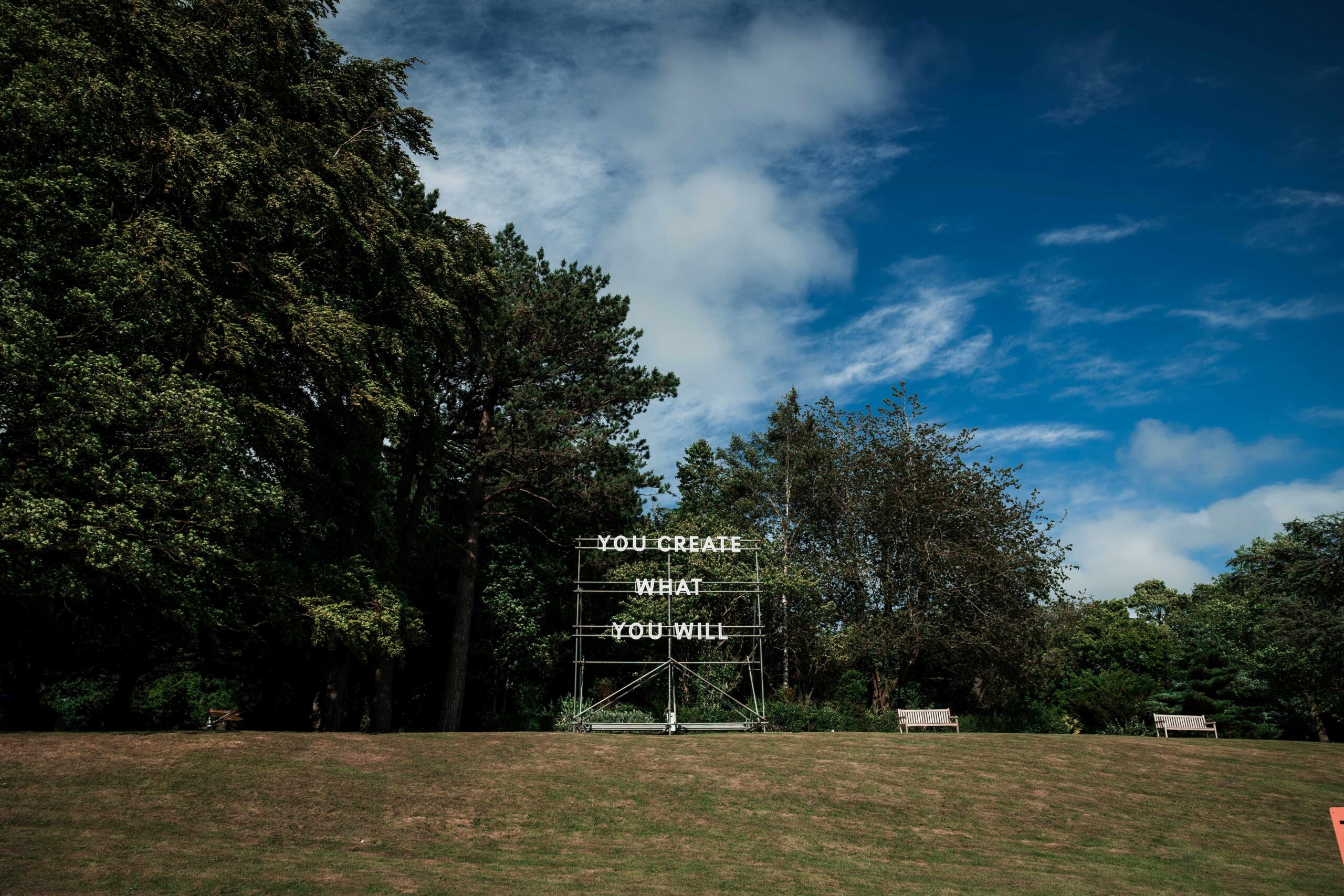
NC: They just said, ‘Would you like to come and have a look, and either see if there’s something here to make a new piece of work from, or if it’s a context that you could imagine showing work that you already have?’ And the conversation quickly went along the lines of, ‘Why don’t we show one of the text works outside?’, because the grounds are quite animated and interesting. And they chose ‘You Create What You Will’ (2014), out of all the ones available.
LG: And so different places pick different text pieces to work within their specific contexts?
NC: Yeah, and I think to some degree they always work the same way: the phrases change due to the context, but just as importantly the context changes when the phrase is introduced to it. So, there’s a nice two-way conversation. I like the way these, as I call them, ‘illuminated texts’ are sculptures rather than text works, and this one, like them all, comes from the world, so I’m never the author – it’s not like I come up with them. The rule is that the phrase needs to already be in existence and that I’m making it mine and then I’m presenting it to you the audience.
LG: Where did these words come from originally?
NC: George Bernard Shaw. It’s from a longer phrase. He says, ‘Imagination is the beginning of creation. You imagine what you desire, you will what you imagine and at last you create what you will’. So, there are three works, and this is the third one.
LG: It’s got a physical presence; it’s pinned to the ground with the scaffolding. We go past it as we come into the museum and come back out with a new experience of that concept perhaps.
NC: Yeah, in the classic way that all sculpture is about scale and form and materiality and your relationship to all of those. It’s a certain size so that it’s visible from a distance; it has taken on the language of the theatre or the fairground, so it’s a little bit gaudy, a bit 1970s dirty, and the scaffolding is functional. I think sculpture is the best way to describe it.

LG: They are quite theatrical; they remind me of theatre mirrors with the lights around.
NC: That’s a nice connection. I think that it’s a little bit celebratory, a bit cheap. The first one I made, the famous one, ‘There Will be no Miracles Here’ (2006), I knew that I wanted to use fairground lights rather than neon because neon is associated with advertising, and the works are not evangelical and they’re not trying to sell you something.
LG: But it also illuminates the person looking at it…
NC: Yeah, it’s nice to make a sculpture that illuminates the world! And at twilight, or in darkness, that sculpture takes ownership of so much, and conceptually speaks to a wider space.
LG: With Durham Cathedral nearby and the local history of the illumination of bibles and manuscripts, I wondered if you’d considered the connection?
NC: It’s a nice connection with the word, because you can illuminate an idea, or a notion, and you can also illuminate a situation. But also, the word makes me think of the seaside, the illuminations on the promenade and all these things make me think of public space. The notion of the illuminated manuscript is for a wider audience, not a particular one, because the picture can be read by everybody. There’s also a whole history of my work dealing with religion and politics as well. I wonder if that’s why I call them illuminated texts.
LG: They’re also meditations, those illuminated manuscripts…
NC: You think that you understand it, then you look away and you look again. But with whose authority are we talking? Who is it saying, ‘You create what you will’? I’m beginning to be a bit more hardcore about it, trying to avoid them being fixed to the museum [in which they’re placed], because then it’s with the museum’s permission that they’re speaking. With that authority. I kind of like to limit that, so it’s on the side where you drive in, it’s not in the collection. And you can see it from the street, and people use the park to run in… There’s that third audience; it’s not the visitors, it’s somebody else.
LG: Can I ask you about the process of developing the works? Do you work with a team or a model maker? Is it collaborative? I’m curious about how decisions get made.
NC: The studio makes the text works; I’ve got two guys who work for me. So, we make them in house. I have notebooks full of phrases. I’m constantly trying to put myself in the place where I can catch them. And that’s either listening to the radio or reading or having conversations with people, and it’s never when I’m trying to come up with one that I find them. It’s almost like they need to find me. I’ve made so many of them now that it’s getting harder, ‘cause they are measured in isolation and they are also measured against the ones that I’ve made. It was easier when there were less of them.
LG: I guess there are always a number of different moving parts, right? You’ve got ideas flowing, you’ve got phrases up on the wall and then you’ve got things happening in the background like commissions and things and the two come together.
NC: Yes, and then, with the models, I wanted to create a different kind of rhythm of making. I like the fact that they take time to make. Is it important that I make them or someone else makes them? As long as they’re made in the way that my mind’s eye wants to see them, then anyone could make them. Interestingly though, ‘Tate Modern on Fire’ (2017), I made.

LG: I was more interested in the collaborative aspect of working with another maker.
NC: I have had similar ones made by other people, mainly because I’ve not had the time to make them, and that’s fine. I think of it as being like the captain of a ship. I have friends and acquaintances who are much more pluralist. I’ve never been a pluralist, I’m not interested in being an artist, a curator, a writer, a DJ and a coffee maker. There are many people who that’s who they want to be. There’s a fashion within a generation younger than me who think that that’s better. I’ve never felt that. So, we do a lot of CAD drawing in the studio, but I don’t want to learn CAD drawing. I’ve got Alex who is a trained architect, a great thinker, maker, he does all the straight-line drawing that the studio needs; he’s really fast, he’s really good.
LG: There was a moment in Glasgow in the 1990s when you could just be an artist, and careers like yours were established. The younger generation who DJ etc. are not doing it because they think it’s cool but because they need to make money.
NC: Oh, I’m not in any way judgemental of other people, if that’s the landscape they live in. And I’ve been very fortunate I’ve been in a situation where I don’t have to [do other work]. I like gathering super smart people around me, it keeps me young.
LG: But that’s how it works right? We’re all helping each other, none of us really work alone.
NC: Right, and it’s an infrastructure which is self-reliant.
LG: What, like we have to make it happen…?
NC: Yeah, you and I rely on other people, friends and acquaintances to keep us emotionally and logistically going.
LG: I ask you this because your work is so big and polished. I know you’re not in the studio screwing in lightbulbs…and it’s good that we talk publicly about it.
NC: It brings us nicely onto the idea of skill though. I think there is a thread throughout a lot of my work which isn’t afraid of hand-skill and skill in terms of making, and I would argue now that that’s quite a radical thing to do. It is the opposite of fast and loose.
LG: We were just looking at the ‘Silver Swan’ (1773) and asking who could make this now? There was a time when craftspeople like James Cox were working hard to out-skill each other, and making these amazing things, and now so many traditional skills are dying out…
NC: And it has magic – it’s magical! It’s also a part of its time and its context.

LG: Could you say something about the interplay of representation and the conceptual in your work?
NC: The Tate Modern model is abstract because it’s taken from the original building and taking the language and changing the scale and changing the material into a kind of motif. The cabinet of curiosities is a self-portrait meets the collection. There’s a mixture of objects I’ve made, like an even smaller model of the building, so there’s a model of Tate Modern inside the model of Tate Modern, and objects I’ve found or acquired that are a part of my world. There are some objects which were bought in the Tate Modern shop. And then there are two artworld references, which you get a prize if you know…
LG: The Guerrilla Girls…and Ed Ruscha.
NC: I need to acknowledge Ed Ruscha’s painting ‘Los Angeles County Museum of Art on Fire’ (1965-68); the sculpture is obviously a reference to that. Ruscha was doing exactly what I’m doing, which was acknowledging that I’m part of this ecosystem where the institution supports me, and I also want to kill it at the same time because it’s problematic. It has power and it sometimes works against you when you think it should work for you.
LG: It’s a very macho room, and it’s a very macho object as well, very phallic. It looks out to paintings of naked women and there’s Napoleon right ahead, and to the right a great big bull! Which is so macho. Although the back is more like a doll’s house to me than a cabinet.
NC: And then The Guerrilla Girls [mask] satisfies a whole other thing because in the objects there’s both still life and there’s landscape and then that’s portraiture. There is also a change in material and a change of technique. The back is more honest; the front is an illusion. The back is like a boy’s bedroom, banging away with bad tools. The screws are still there; it’s a bit hokey. I think in that gallery it’s interesting because that swan is this performative object, and ‘Tate Modern on Fire’ in a different way is performative too, as we’ve been saying: you see the front of the building, and you go back and there’s a change of scale and a change in the conversation; one side is closed to you as the viewer and the other side is very open and there’s a different relationship to you as the viewer. And I think the swan is a bit like that as well. Most of the time it’s just sitting there looking at you, and then once a day…
LG: …at 2pm…
NC: …it starts being rock and roll. I think that in the digital age that we live in, I’m like us all, stuck to my phone, and too often dealing with non-real entertainment, and there’s something about going for a run, and running past a text, a sculpture in the grounds that has no purpose, other than for you to look at it. It’s not selling you something; I’d argue it’s not entertaining you, it’s not titillating. Human beings are still interested in the real moment, you know? A real thing with materiality and shape and scale and birdsong outside and walking across the creaky floor and coming across a strange object. It begs the question, imagine a place without that? That’s quite bleak.
LG: That’s a great place to end, I think.
Lesley Guy is an artist and writer based in Newcastle upon Tyne.
Nathan Coley’s works ‘You Create What You Will’ (2014) and ‘Tate Modern on Fire’ (2017) are on display at The Bowes Museum, 14 June 2025 – 1 March 2026.
This interview is supported by The Bowes Museum.
Published 21.07.2025 by Benjamin Barra in Interviews
2,292 words